Led Zeppelin
Led Zeppelin are a popular British band best known for their iconic "Stairway to Heaven" as well as for co-creating the music genre of heavy metal. Since their nine albums were recorded between 1968 and 1979, Led Zeppelin has been one of the most popular bands of all time, having sold more than 300 million records and millions of concert tickets worldwide.
The quartet was conceived at the end of the Hippie love era, in a group marriage of blues, rock and roll, soul, rockabilly, folk ballad, jazz, classical and Eastern music, and something else scattered over some woozy sounds of their songs. It was their mutual artistic stimulation, their group interplay and imagination that incorporated mythology and mysticism, and concocted their inimitable style, and established the concept of album-oriented rock career.
Jimmy Page was already an experienced lead guitarist who worked with multi-instrumentalist John Paul Jones in 1967, and they agreed to work on the next project. In August 1968 Page invited Robert Plant and John Bonham to join his band, the New Yardbirds, for a September tour in Scandinavia. In October 1968 they took the name Led Zeppelin, which stemmed from a humorous conversation among several musicians about their chances of going down like a lead balloon. However, British bands were highly anticipated in the USA, and the Atlantic Records founder Ahmet Ertegun signed the new band without even seeing them.
Their debut album, 'Led Zeppelin', recorded and mixed in just about 36 hours in October 1968, at Olympic Studios in London, kicked open the door for all extremes and experiments. The phallic image of the blown up Hindenburg airship on the cover, designed by George Hardie, announced the hardening of rock and coming of the new super-group. While ascending to musical success as a powerhouse band, Led Zeppelin explored a variety of styles, from English folk ballads to blues and rock, and created their own inimitable style.
Prior to the release of their first album, Led Zeppelin made live appearances at the University of Surrey and in London in October 1968, then went on their first American tour in December 1968. In their first year, Led Zeppelin made four concert tours in the USA, and another four tours in the UK. Their second album was recorded entirely on the road at several American recording studios, and was an even greater success than the first one. "Whole Lotta Love", "Heartbreaker", "Living, Loving Maid", and "Ramble On" became big international hits.
Each member of the quartet contributed to their compositions, thus setting a fine example of group creativity. Their songs and albums rambled on with the highly versatile voice-guitar interplay. Plant's incredible vocal range and Page's enchanting guitar solos were as responsible for the band's singularity as its musical wanderlust. Plant's and Page's musicianship was supported by the tight playing by John Paul Jones on bass, and John Bonham on drums. The intense interaction of all four players on stage gave their live performances a visual counterpoint to well intertwined harmonic and rhythmic structures of their compositions.
Their third album, Led Zeppelin III, influenced by folk and Celtic music, offered more inventiveness with acoustic/electric sound-work, and revealed more of the band's versatility with such compositions as the "Immigrant Song" and "Since I've Been Loving You". With the release of their fourth, and most popular album, Led Zeppelin achieved a reputation of the biggest band in the world. 'Stairway to Heaven' became the most played radio hit, several other songs became rock classics, and nobody knows how many more times their lines would help other musicians (like the opening riff from "How Many More Times" was later used by Pink Floyd in their hit "Money").
Capitalizing on the success of their first four albums, the band toured extensively in the 1970s. At that time they chartered a private jet, nicknamed the Starship, that carried the band's name and later added the famous 'Swan Song' winged Apollo image on the tail. Going to California turned into a ritual of wildness and excess, most notably at the Hyatt House hotel on the Sunset strip in Los Angeles, known colloquially as the "Riot House" for a series of some most exciting off-stage events, such as riding a motorcycle inside the hotel and throwing TV set out of the window. One of their concerts under a heavy thunderstorm in Florida ended with police using tear gas, and led to a temporary pause in their concert tours.
During the 70s their career was interrupted several times by accidents, deaths and other unfortunate events. In September 198O on the eve of an American tour, John Bonham accidentally died from pulmonary edema after a day of drinking. In December 1980, Led Zeppelin disbanded, albeit the public could still feel their presence. In 1982 a collection of out-takes from various sessions from the 70s was released as their last album, Coda. During the 80s the remaining three members experienced a serious communication breakdown, until they briefly united for a short set in 1985, and once again, in 1988, with Bonham's son, Jason, for the Atlantic Records 40th Anniversary show.
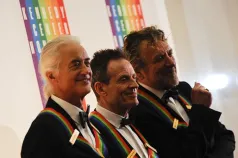
In 1994 Page and Plant showed their softer side when they performed live together on 'MTV Unplugged', which was released the same year as album titled 'No quarter'. Then they made an international tour with an orchestra. In 1995 Page and Plant were joined by Jones when the band was inducted into the Rock and Roll Hall of Fame, albeit the three former band-mates did not perform together. By that time Jimmy Page as well as Robert Plant had pursued individual careers touring and recording with their own bands.
Another ten years gone. Page's and Plant's call-and-response interplay took them through good times and bad times. Their sonic originality had sparked imagination and creativity in millions of open minds. Singers, songwriters, armies of music fans and a rainbow of dedicated 'led heads', as well as guitarists and guitar collectors worldwide remained united through the acquired experience and conditioning to the Led Zep sounds.
Hats off to Led Zeppelin, who opened the new extremes of musical expression, and are now back in the light confirming their presence. Their long anticipated reunion in December 2007 was a true celebration day. Their live performance was as tight as a rock band can be, and their living, loving song remains the same since we've been loving them. That's the way!
Thank you, Friends.